



A landlord recommendation letter gives a prospective landlord a factual account of someone’s tenancy. A useful letter identifies the rental property and tenancy dates, describes payment history and relevant firsthand observations, and includes the writer’s signature and contact details.
You don’t need to make the tenant sound perfect. You need to say what you can honestly confirm. The four Word and PDF templates below cover a former tenant, payment history, a current tenant and a neutral confirmation when you’re not offering a recommendation.
Choose a letter that matches what you can confirm
Start with the purpose of the request. A new landlord may want a short recommendation, a record of rent payments or simply confirmation that the applicant rented from you. Ask which information is needed before adding personal details.
Each letter is an editable Word document with a matching one-page printable PDF. Edit the Word file for your situation; the PDF is a print copy, not an interactive form. Replace the bracketed prompts and have the actual writer check the finished letter before signing.
1. Former tenant recommendation
Use this letter when the tenancy has ended and you can give a supported recommendation. It provides space for the rental dates, payment history and observations about the property. Mention a move-out inspection only if it took place and you have the record; don’t imply that a final inspection or deposit account is complete when it isn’t.
Former tenant recommendation
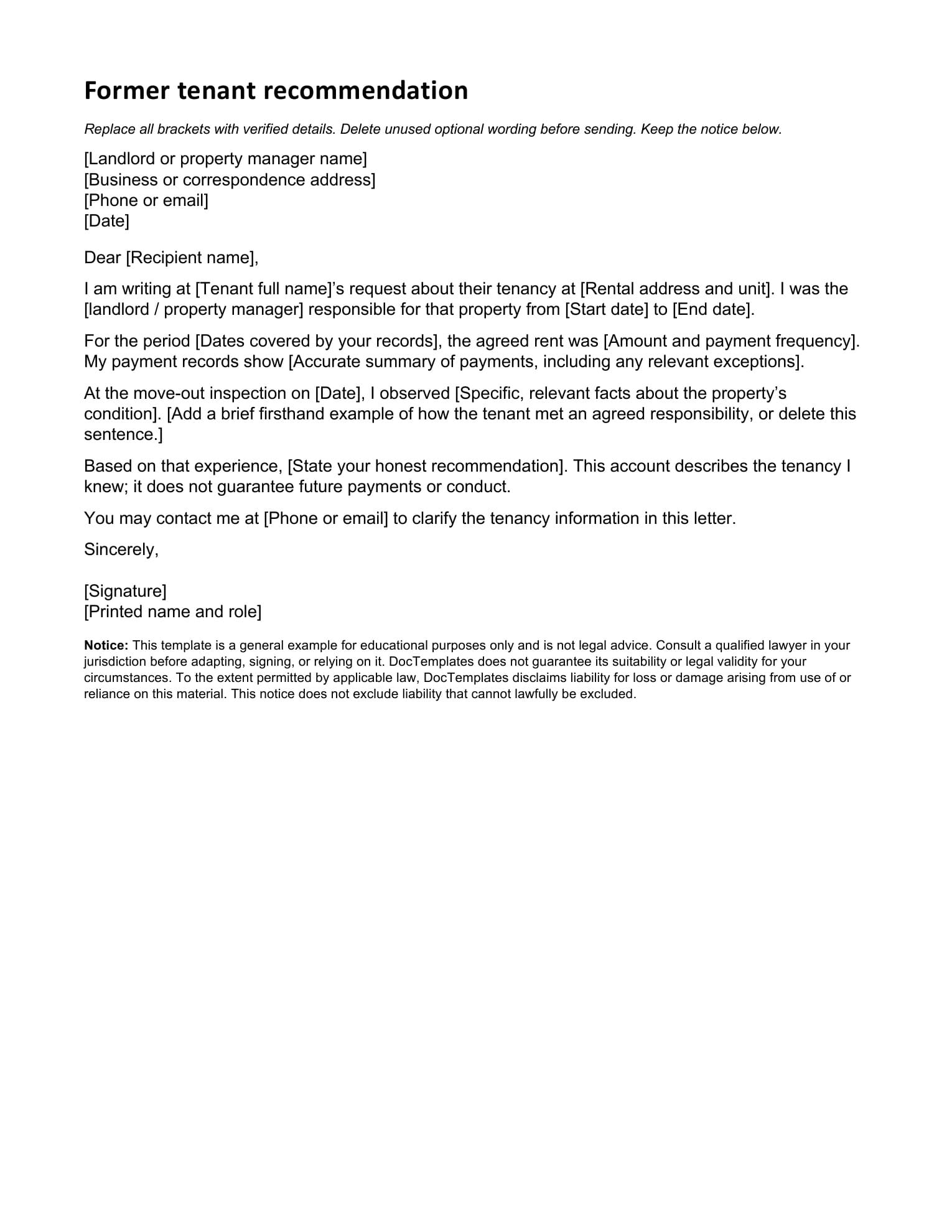
Former tenant recommendation
2. Payment history reference
If the request is mainly about rent, keep the answer tied to the records. This version lets you identify the period reviewed and describe any exceptions accurately. For example, distinguish a payment received late from an unpaid balance; they are different facts. Avoid predicting what the tenant will be able to afford in a future home.
Payment history reference
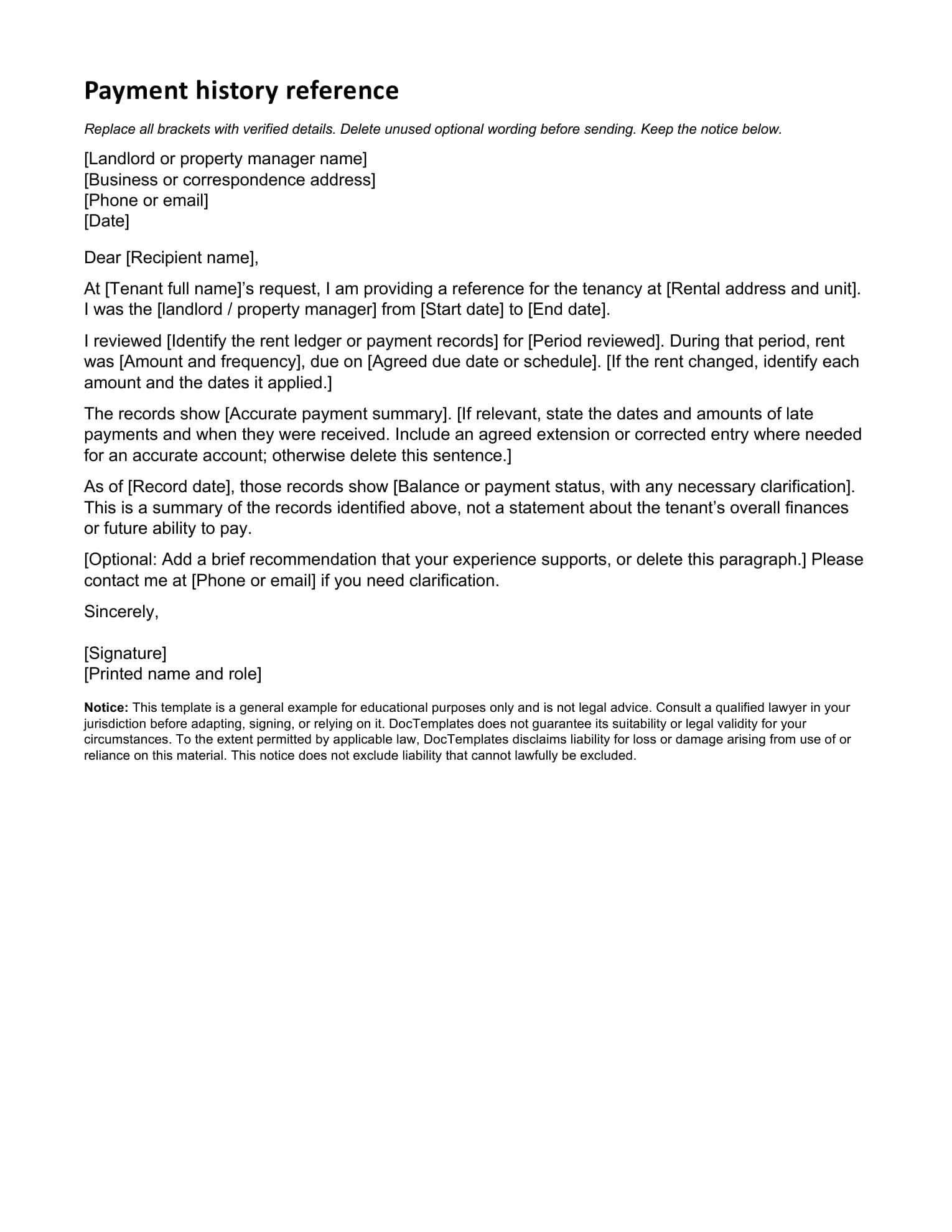
Payment history reference
3. Current tenant reference
A tenant may need a reference before moving out. Use this version to confirm the tenancy and describe what you know as of the letter’s date. It leaves the future move-out condition, remaining payments and deposit accounting open instead of treating them as settled.
Current tenant reference
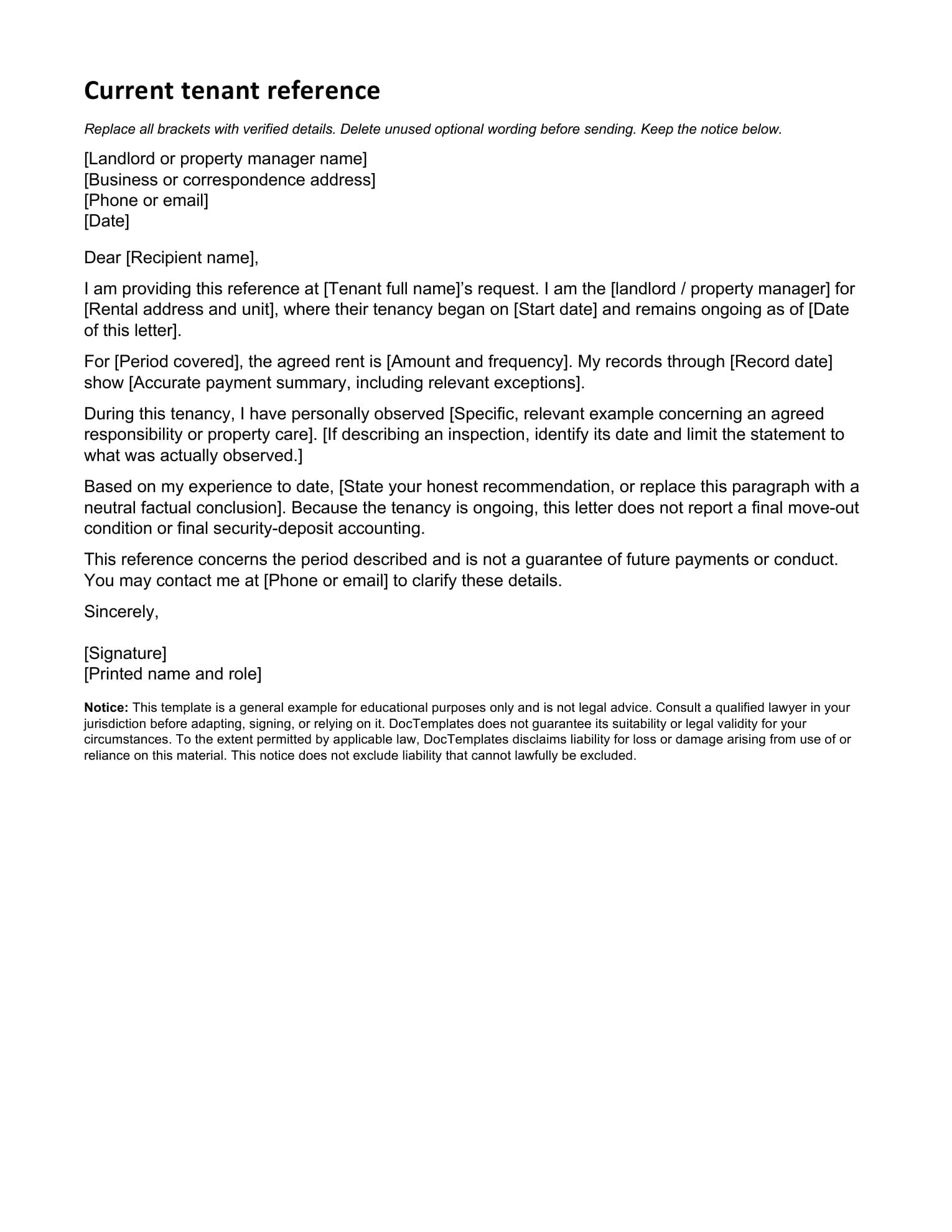
Current tenant reference
4. Neutral tenancy confirmation
Sometimes you can confirm names, an address and dates but cannot offer a broader endorsement. This short confirmation gives you that option. It states the limited facts you can verify without presenting the letter as a positive recommendation.
Neutral tenancy confirmation
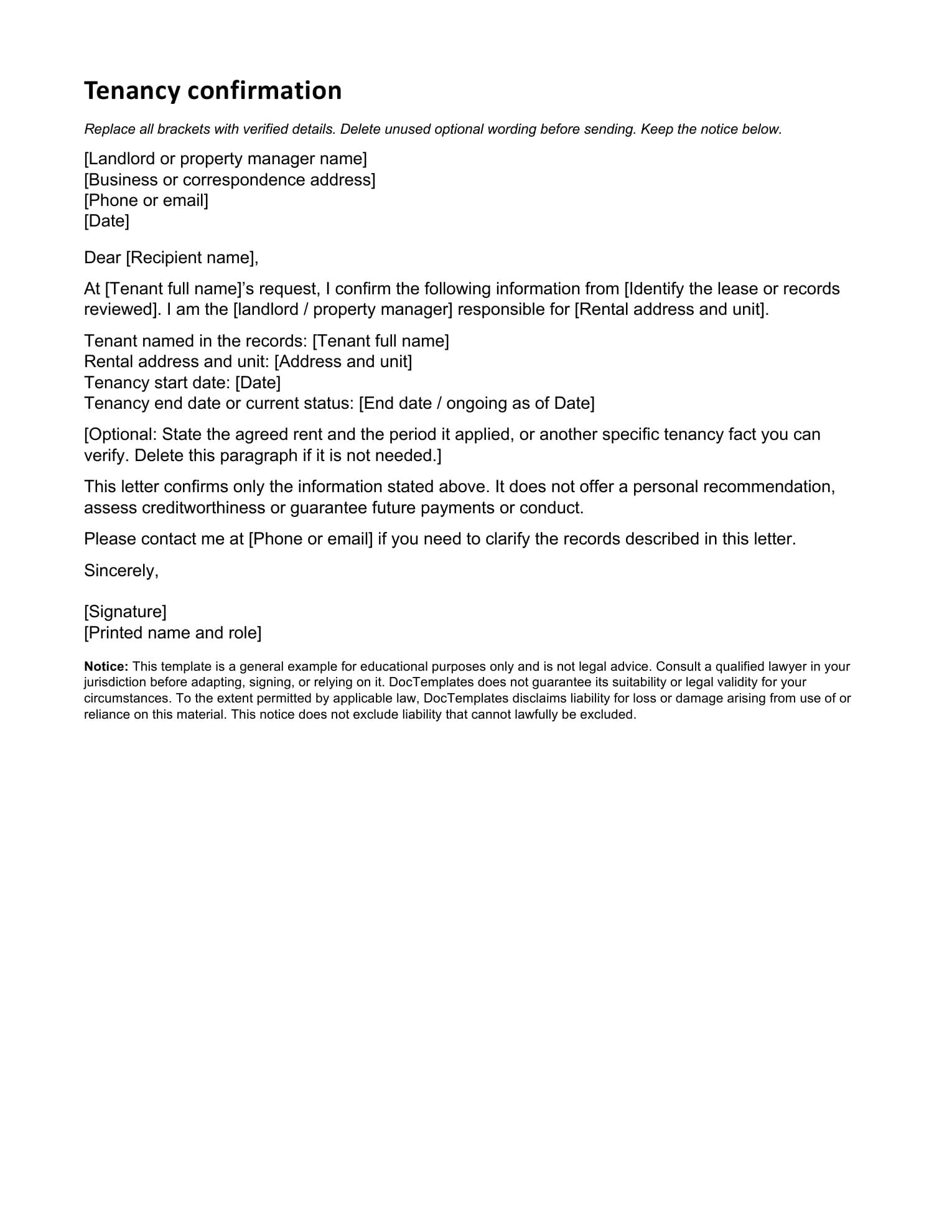
Neutral tenancy confirmation
What to check before writing
Open the relevant tenancy records before you start. Memory can blur dates or turn one late payment into a broader impression. Check:
The tenant’s correct name, rental address and unit number.
The tenancy’s start and end dates, or whether it is still continuing.
The period covered by the payment records and any balance as of a specific date.
Inspection notes or other records supporting observations you intend to include.
The requested recipient, delivery method and deadline.
Use existing receipts and payment records to verify amounts and dates. If you need a format for documenting future payments, see our rent receipt templates.
A receipt template cannot establish that a past payment happened. If your records are incomplete, narrow the letter to what you can confirm instead of filling gaps with assumptions.
How to write a clear landlord reference
Introduce yourself and the tenancy
State whether you are the landlord or property manager, identify the tenant and property, and give the relevant dates. A current reference might begin: “I am the property manager for [address], where [tenant name] has rented since [start date]. This reference describes the tenancy as of [letter date].”
Describe payment history precisely
Give the period you reviewed and use wording that matches it. “My rent ledger for January through December shows that each payment was received by its due date” is more useful than “This tenant is financially secure.” The first statement describes your records; the second makes a much broader claim.
If you discuss an exception, check its date, amount and outcome. Don’t turn a payment disagreement into an accusation or disclose unrelated financial information. Get appropriate advice if a disputed issue or disclosure obligation affects what you can say.
Add relevant firsthand observations
Describe what you actually observed: communication about repairs, care of the property during documented visits, or the condition recorded at a completed inspection. Avoid assumptions about someone’s character based on their age, family, background or health. “They reported the leaking tap promptly” is concrete; “People like them always make good tenants” is not.
Make the recommendation proportionate
If you can recommend the tenant, say so briefly and connect the recommendation to the tenancy you observed. You are not guaranteeing future rent or promising how the person will behave elsewhere. When you cannot support an endorsement, use a neutral confirmation or explain the limits of the information you can provide.
Finish with a date, signature and contact details
Give the writer’s name, role and a suitable contact method. Confirm any recipient requirements for signatures or delivery rather than assuming a particular format will be accepted. Read the final letter once more after editing; an overlooked bracket or old date can change its meaning.
Sample landlord recommendation letter
The following example is fictional. Its dates, payment history and observations are illustrations, not statements to copy unless they are true of the tenancy you are describing.
[Landlord’s name]
[Business mailing address]
[Email or phone]
[Date]
Dear [Recipient’s name],
I was the landlord for [Tenant’s name] at [Rental address and unit] from January 1, 2025, through December 31, 2025.
My rent ledger for that period shows that the monthly rent of $1,400 was paid by the agreed due date each month. During the tenancy, [Tenant’s name] communicated promptly about a plumbing repair and arranged access with me. At our documented move-out inspection on December 31, the rooms were clean and I observed no damage beyond ordinary wear.
Based on my experience during this tenancy, I would recommend [Tenant’s name] as a prospective tenant. This reference reflects my records and observations from that period; it does not guarantee future payments or conduct.
Please contact me at [Email or phone] if you need to verify the information in this letter.
Sincerely,
[Signature]
[Printed name and role]
When a positive reference does not fit
You may have managed the property only briefly, inherited incomplete records or have a genuine concern about making a recommendation. A request for a reference does not mean you should manufacture praise. A limited statement such as “Our records show that [name] rented [unit] from [date] to [date]” makes its scope clear.
For a current tenant, avoid writing that the property was left in good condition or that all obligations were fulfilled before the tenancy ends. Use an “as of” date and distinguish completed observations from events that have not happened yet.
Where there is an unresolved dispute, a complaint or uncertainty about what may be disclosed, seek qualified advice. A general template cannot decide those issues for you.
How to ask for and send the letter
If you’re the tenant, make the request easy to answer. Include the address you rented, the dates, the intended recipient and a reasonable deadline. For example:
“Hello [Name], I’m applying to rent a new home. Would you be comfortable providing a reference about my tenancy at [address] from [dates]? The property manager has asked for [information] by [date]. I can send their contact details and a blank template if helpful. Please let me know whether you’re able to provide it.”
You can offer a blank form or point out an incorrect date, but the landlord or manager must check the statements and authorize their own letter. Don’t sign or send it as though you are the landlord. If a reference is unavailable, ask the prospective landlord which alternative records they accept.
For the writer, confirm the recipient’s details and send the checked letter through the agreed private channel. Include only information relevant to the request, and follow applicable privacy and record-handling requirements.
Keep the reference relevant and check local requirements
Housing and screening rules vary. In the United States, the federal Fair Housing Act prohibits housing discrimination based on race, color, national origin, religion, sex, familial status and disability. Keep reference wording focused on relevant tenancy facts, and check any additional protections or requirements that apply locally. Read HUD’s overview of federal housing protections.
A letter also does not replace a lawful screening process. The FTC identifies reports from tenant-screening and reference-checking services as examples of consumer reports; using a consumer report for an adverse housing decision can trigger notice obligations. If a reporting service is involved, review the applicable requirements rather than assuming every reference follows the same rules. See the FTC’s guidance for landlords.
Before sending your letter, check the names, dates, factual statements, remaining placeholders, signature and recipient. A short reference that accurately reflects your knowledge is more useful than a sweeping recommendation you cannot support.
