



Separation can leave you making practical decisions while much of the future is still unsettled. Housing payments, access to financial records and children’s routines may need attention now. These editable examples help you organize those issues, distinguish an agreement from a court process and prepare specific questions for independent legal advice.
Start with the general or temporary agreement example, then use the parenting and property worksheets where more detail is needed. The aim is a clear record of proposed terms, supporting information and unresolved decisions. Signing a private document does not by itself end a marriage or establish that every proposed term is enforceable.
Start with the arrangement you need to discuss
Educational example notice
This template is a general example for educational purposes only and is not legal advice. Consult a qualified lawyer in your jurisdiction before adapting, signing, or relying on it. DocTemplates does not guarantee its suitability or legal validity for your circumstances. To the extent permitted by applicable law, DocTemplates disclaims liability for loss or damage arising from use of or reliance on this material. This notice does not exclude liability that cannot lawfully be excluded.
Use the Word file or make a Google Docs copy to edit. The PDF is a reference copy of the blank example, not an interactive fillable form. Two files are agreement examples; the other two are companion worksheets and should not be mistaken for standalone court documents.
General financial and living arrangements
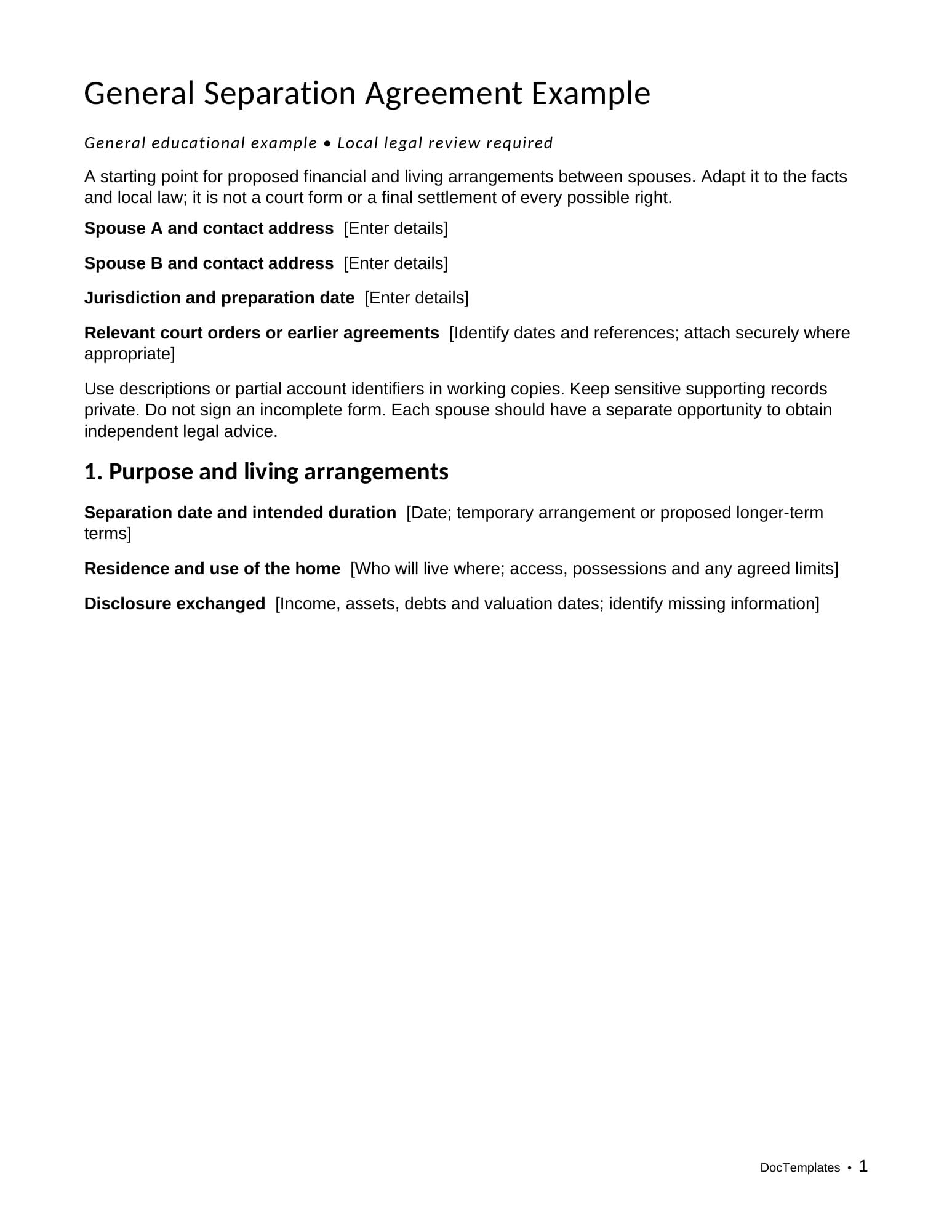
The general example organizes proposed living arrangements, disclosure, bills, support and implementation steps. It leaves unresolved matters visible instead of inserting automatic waivers of rights. Use a separate property schedule when the assets and debts need more detail.
General Separation Agreement Example
General Separation Agreement Example
Temporary arrangements while other issues remain open
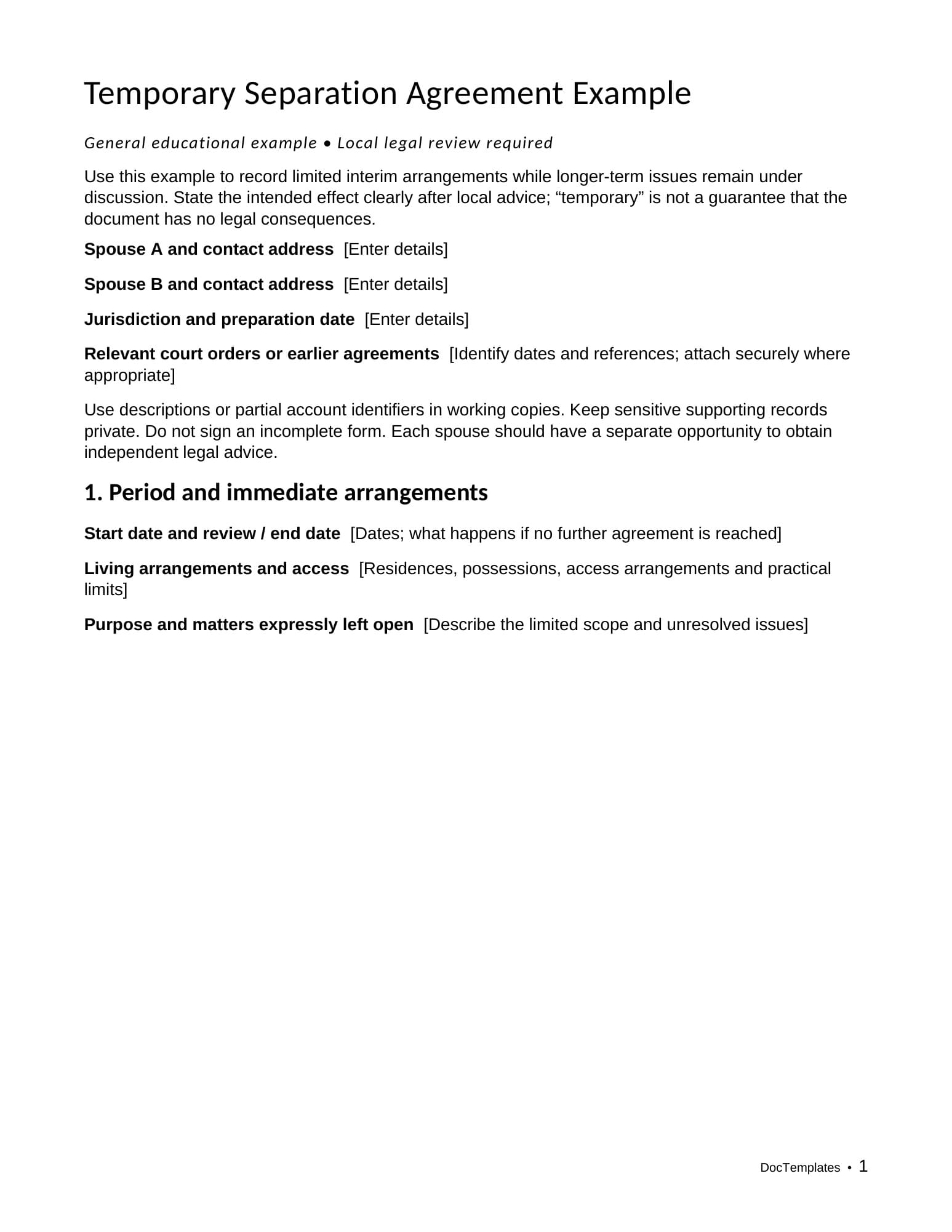
The temporary example focuses on a defined period, immediate bills, access to records and a review date. State which issues it covers and which remain open. Calling an arrangement temporary does not establish its legal effect; discuss that with your own adviser.
Temporary Separation Agreement Example
Temporary Separation Agreement Example
Parenting and property details
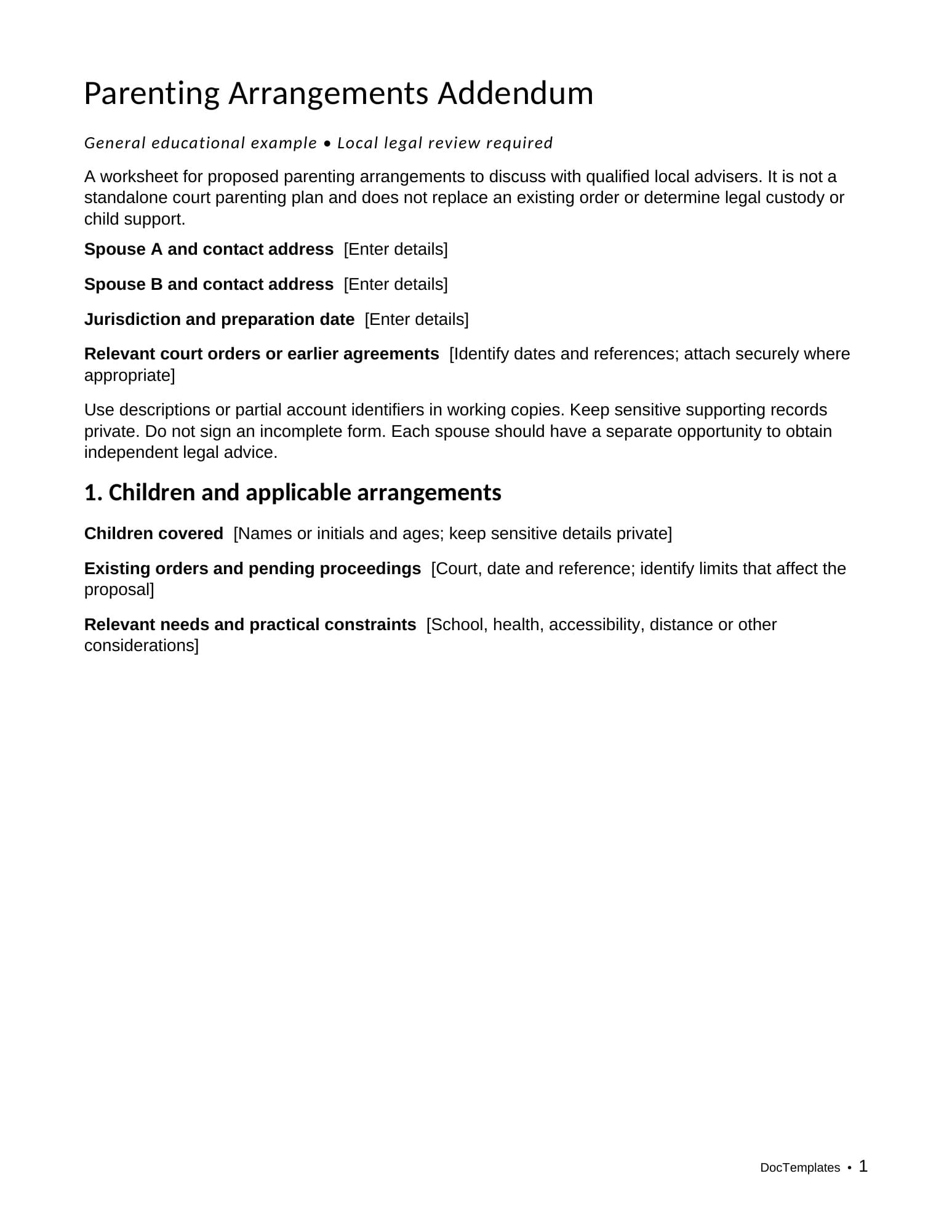
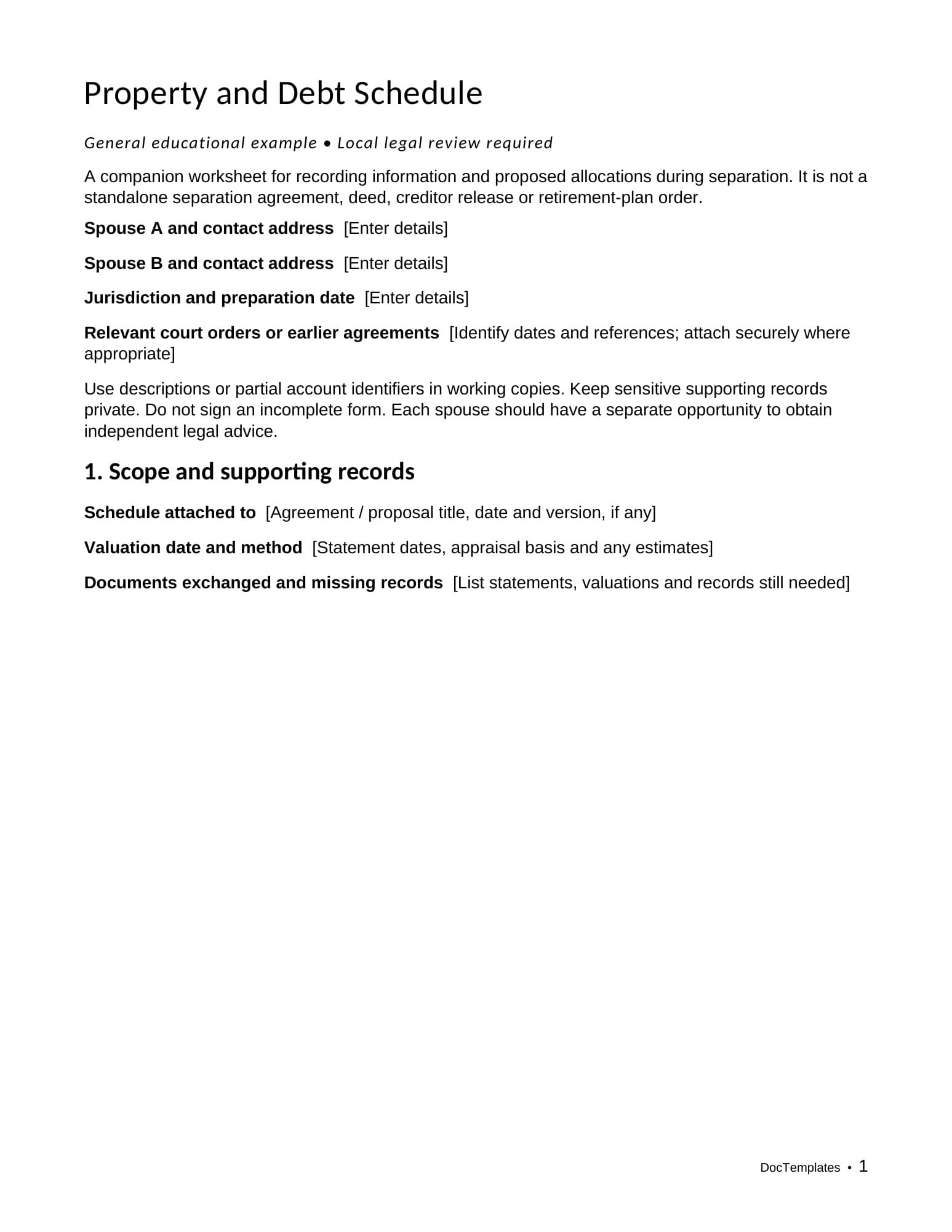
The parenting addendum is a place to record a proposed routine, holidays, exchanges, communication and questions about decisions or costs. The property and debt schedule records ownership, values, balances, proposed allocations and the separate steps needed to carry them out. Neither worksheet replaces an applicable order or required transfer document.
Parenting Arrangements Addendum
Parenting Arrangements Addendum
Property and Debt Schedule
Property and Debt Schedule
Understand what a separation agreement can and cannot do
A private separation agreement is a contract addressing matters between spouses. Legal separation can describe a status or a court process, depending on the jurisdiction; it does not necessarily mean a court has approved your agreement. Divorce is the legal process that ends the marriage. A private agreement, living apart and a final court judgment therefore have different roles.
North Carolina’s courts explain that spouses can be separated without a written agreement and describe state-specific requirements for a separation contract, including notarized signatures. California’s judicial legal-separation process can resolve property, debt and support issues while the spouses remain married; a divorce ends the marriage. Use these as examples of the distinctions, then check the law and required process where your case belongs.
North Carolina courts: Separation and divorce
California courts: Legal separation
If an order already applies, give a copy to your lawyer before drafting different terms. Do not assume a private document can override it or that signing an example completes a court process. Ask what formal steps are required for the particular arrangements you want to make.
Gather information before deciding the terms
With those distinctions in mind, build a reliable information file before negotiating allocations. Gather income records, account and loan statements, housing costs, insurance and retirement-plan details, and existing agreements or orders. Date the figures and label estimates, disputed values and missing records.
Use the property and debt worksheet to keep facts separate from proposals: current ownership and balance in one place, proposed allocation and implementation step in another. This creates one shared reference for the drafting work rather than repeating the same figures throughout the agreement.
Use partial account identifiers in working copies and exchange sensitive supporting records privately. A publicly shared template is a blank starting point, not a place to enter personal information. Make a private copy and check its sharing settings before adding details.
Turn a proposed arrangement into clear responsibilities
Next, turn each proposal into an action someone can carry out. For a bill, identify the amount or calculation, each person’s proposed contribution, the payment date and method, the record to keep and a review date.
For example, an invented monthly housing payment of 1,200 currency units might have proposed contributions of 700 and 500. Specify who sends the payment to the lender, when the other contribution must arrive and how a changed bill will be handled. The figures illustrate the detail to record, not a recommended allocation.
For an asset or debt, use the schedule’s implementation column to identify the next required document or third-party response, who will obtain it and by when. Leave unverified steps unresolved. The separate creditor and specialist checks below explain why allocation alone may not complete the transaction.
Give children and long-term finances separate attention
A workable parenting proposal starts with the children’s routines, needs and any existing orders. Record ordinary days, school breaks, exchanges, communication and how changes will be discussed. A calendar does not itself determine custody or child support. North Carolina’s guidance illustrates that a court may make child-related decisions despite a private agreement; check the actual rules for your family.
For an illustrative discussion draft, parents might record a Friday exchange after school, a Sunday return at an agreed time and location, who provides transport, and how they will notify each other of a delay. Add a separate holiday plan, a way to share school or medical information and a review date. This shows the decisions to document, not a recommended schedule or a substitute for a child-focused legal assessment. Where safety or coercion is a concern, obtain appropriate help before proposing joint exchanges or negotiations.
Debt also needs a separate check. The Consumer Financial Protection Bureau explains that allocating a debt in a divorce settlement does not automatically change the creditor’s rights against a borrower. If a proposal depends on removing a name from a loan or refinancing, record that external step rather than assuming the private agreement completes it.
CFPB guidance on debt after divorce
Retirement benefits, insurance, property transfers and taxes may need specialist advice or additional documents. Avoid a blanket statement that all support payments receive the same tax treatment. IRS Publication 504 describes rules that depend on the facts and the dates and terms of the relevant instruments; use current advice for your own circumstances.
IRS Publication 504: Divorced or separated individuals
Review before signing
Before signing, check the chosen example against the information file and schedules. Confirm names, dates, amounts, responsibilities and cross-references; remove unused prompts. Keep disputed terms, missing evidence and outstanding decisions on a separate advice list.
Each spouse should have the opportunity to obtain independent advice from a qualified lawyer in the relevant jurisdiction about disclosure, voluntariness, legal effect, signing requirements and court or third-party steps. A signature line, witness or disclaimer does not prove validity. If coercion, abuse or an immediate safety concern affects the situation, seek appropriate local help before attempting a joint drafting exercise.
The useful outcome is a documented arrangement that both people understand, supported by the right records and the required legal process. Once that process is settled, retain the same completed agreement, attachments and later agreed changes. A well-organized draft helps each person obtain advice; it cannot replace that advice.
