


A massage room rental agreement records how a practitioner may use a treatment room, what rent they will pay and who handles the everyday responsibilities. Before you commit to a space, put the room, access hours, payment arrangement and included services into the same written document.
The general example below gives you a place to work through those details with the space provider. It includes an access schedule, three rent choices, an equipment and cleaning checklist, signature fields and a separate page of instructions. It is designed for an ongoing treatment-room arrangement, with either exclusive use or shared use at scheduled times. It is not an open booth or station rental, a residential room rental or a client consent form.
Download the massage room rental example
Massage room rental agreement — general example
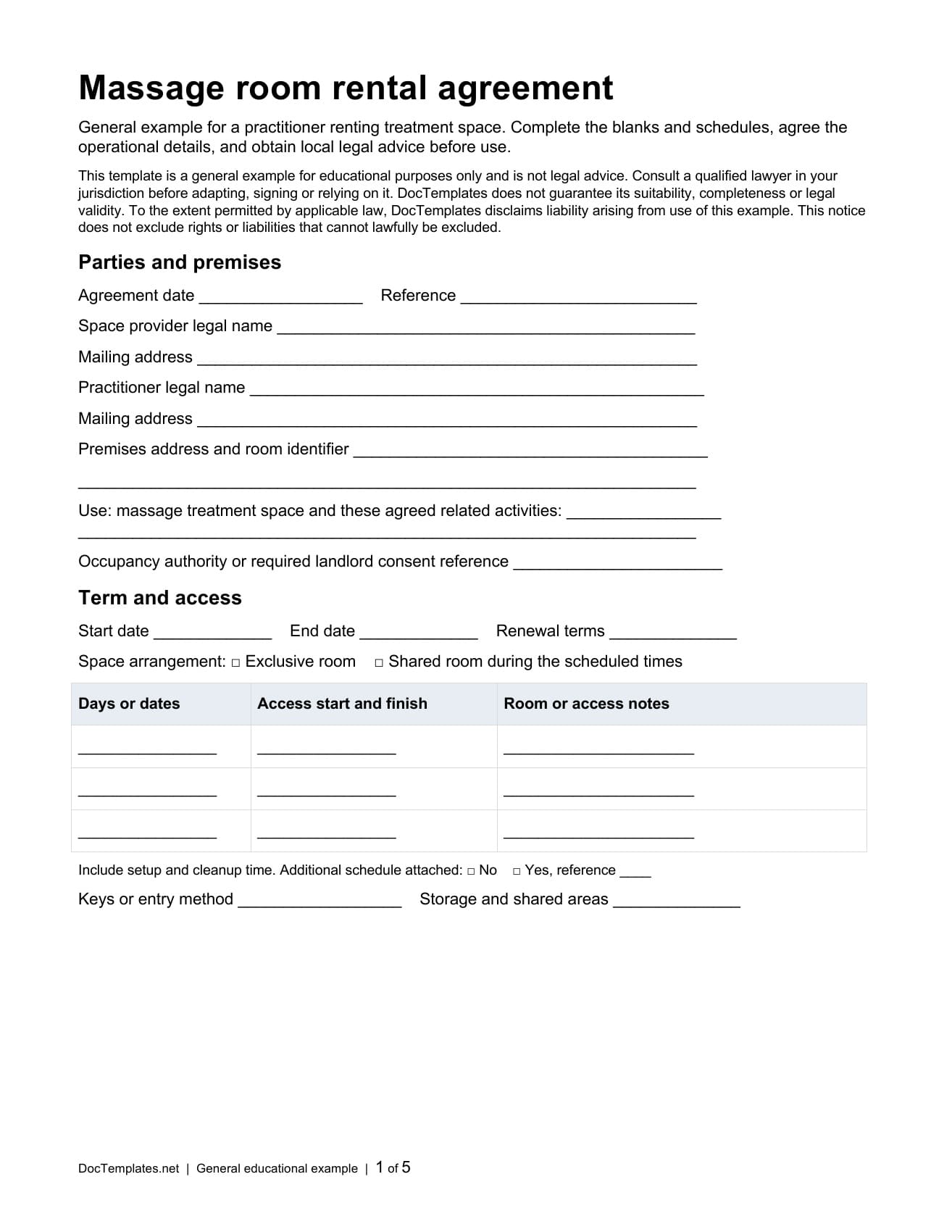
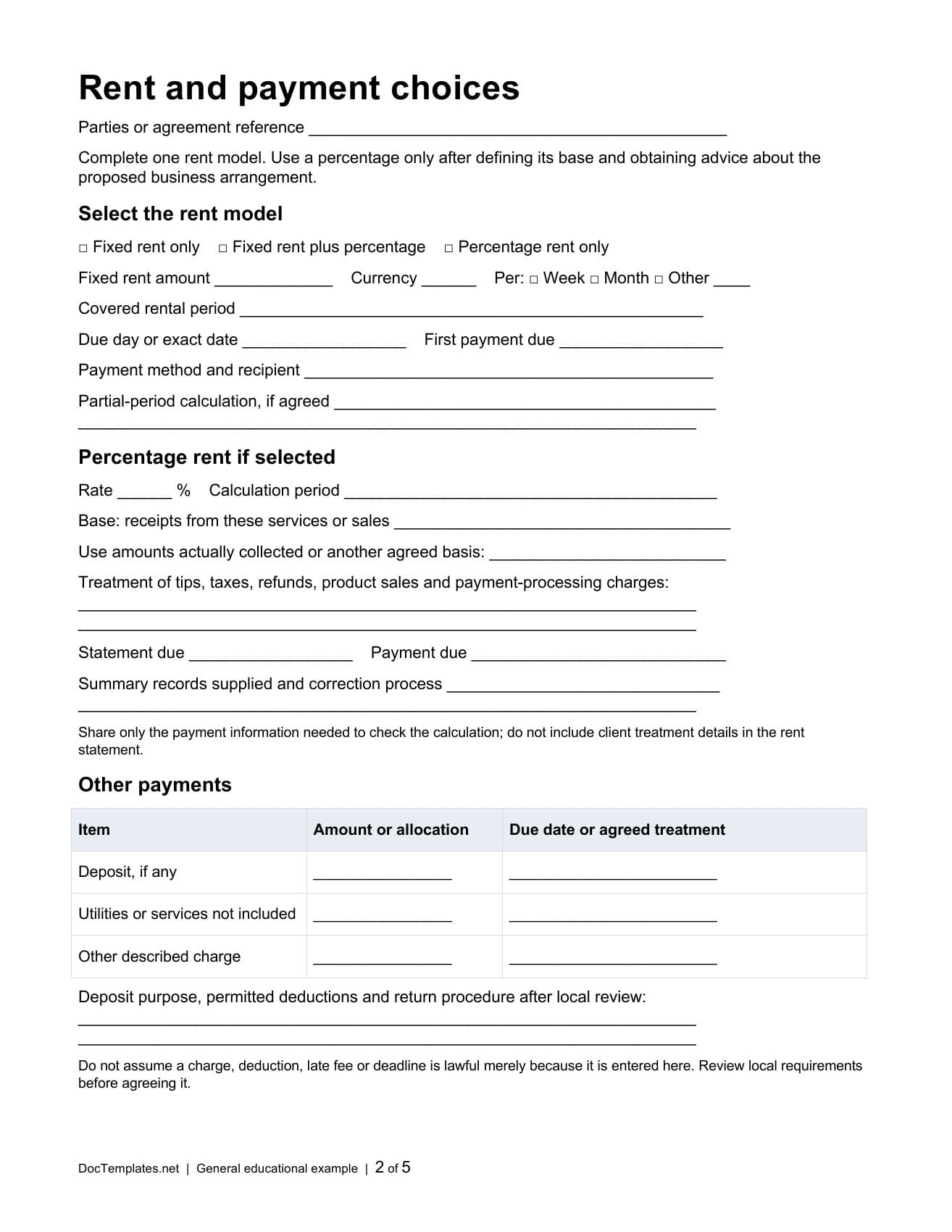
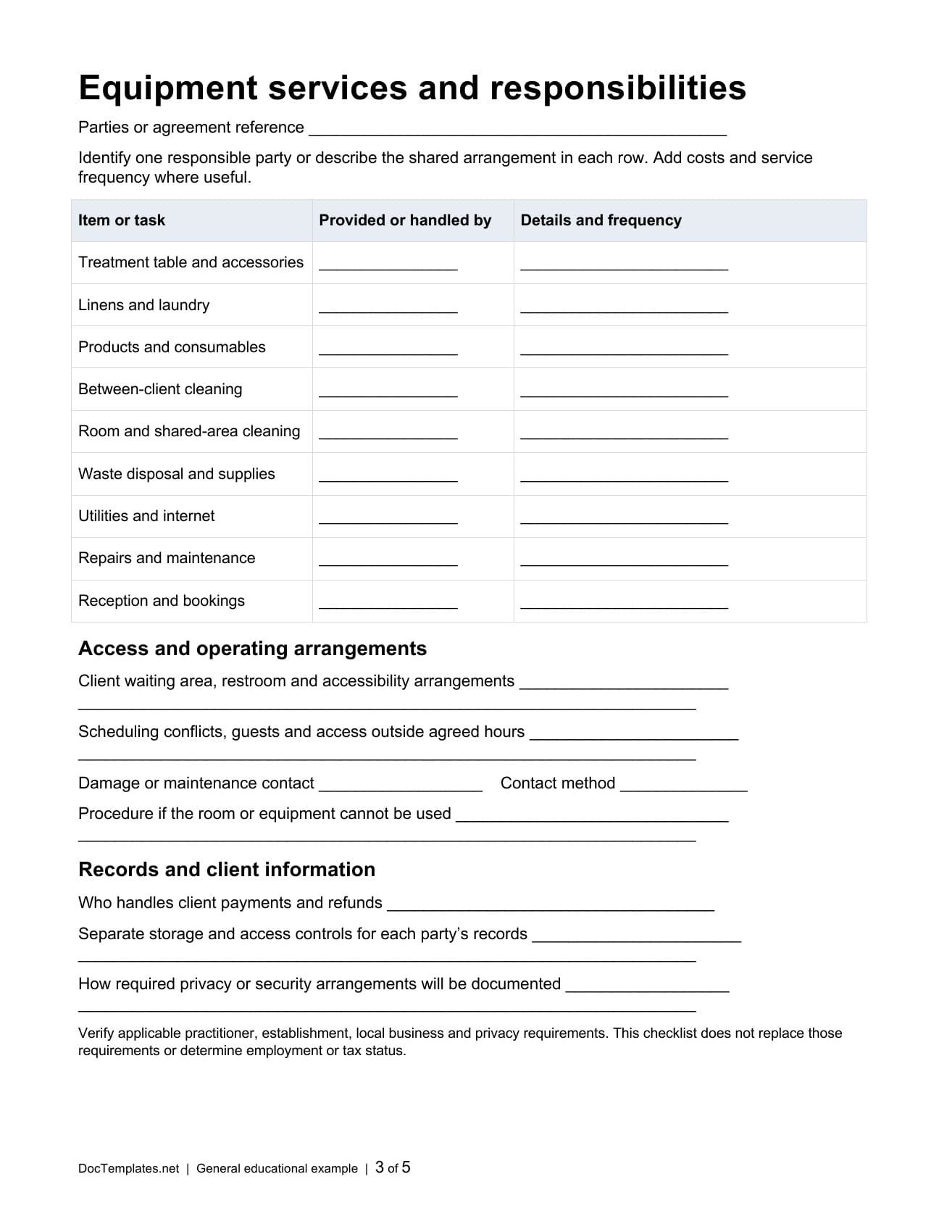
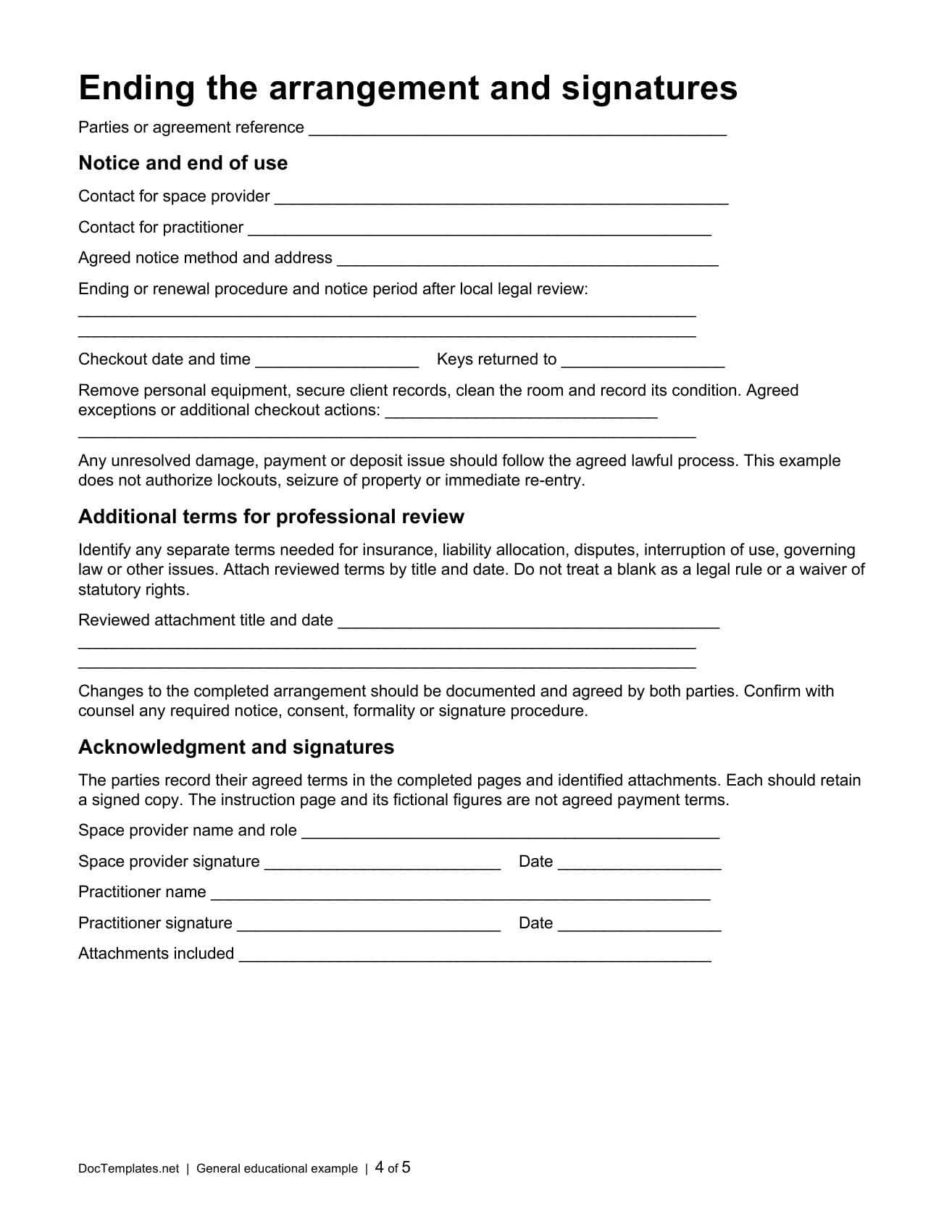
Massage room rental agreement — general example
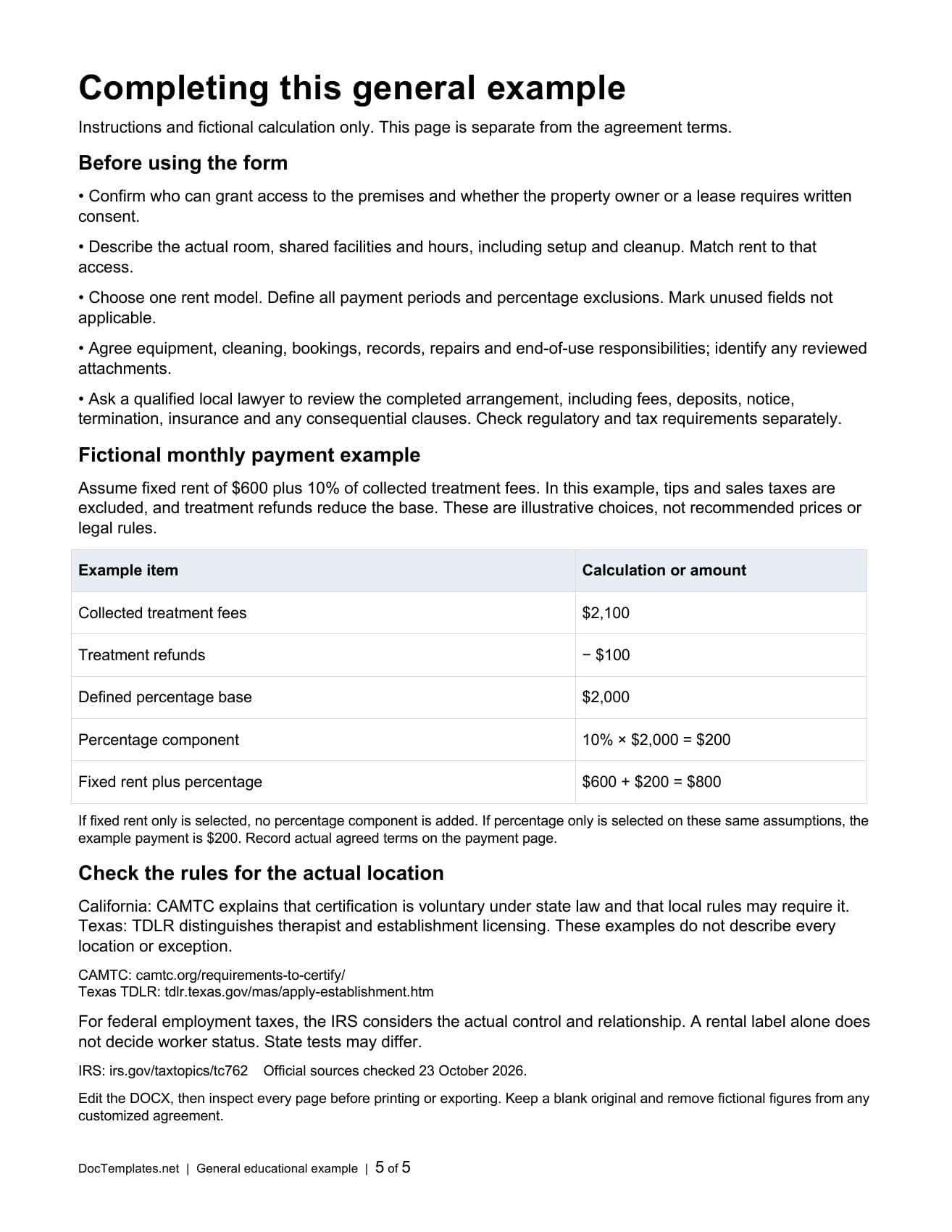
The five-page file contains four pages of agreement fields and checklists, followed by one instruction page with a fictional payment example. Edit the Word version to reflect the arrangement being considered. The PDF is a static print copy, not an interactive form. Keep the instruction page as guidance; it is separate from the agreement’s signature section.
The preview gallery shows all five pages: parties and room access, rent and charges, equipment and responsibilities, ending the arrangement and signatures, and instructions with a payment example.
This template is a general example for educational purposes only and is not legal advice. Consult a qualified lawyer in your jurisdiction before adapting, signing or relying on it. DocTemplates does not guarantee its suitability, completeness or legal validity. To the extent permitted by applicable law, DocTemplates disclaims liability arising from use of this example. This notice does not exclude rights or liabilities that cannot lawfully be excluded.
Agree on the room and access before the rent
Start with the full names and contact details of the space provider and practitioner, then identify the premises and the particular treatment room. If several rooms look alike, attach a simple room label or plan so both parties are referring to the same space.
Specify whether the treatment room is reserved exclusively for one practitioner or shared by practitioners at scheduled times, and fill in the actual days and access hours. Include time for setting up and cleaning between appointments. A promise of “Tuesday access” leaves room for disagreement if one person expects the whole day and the other expects only the booked treatment hours.
Discuss keys, storage, waiting areas, reception and any shared facilities at the same time. Check that the person offering the room has authority to do so. If that person is a tenant, the existing lease and any required landlord permission need attention; a separate landlord consent to sublease example can help identify that different document’s purpose. The room agreement itself does not establish that permission.
Choose one rent arrangement
The template separates three possible arrangements. Select the one being discussed and complete its terms rather than leaving conflicting boxes checked.
Fixed rent only: an agreed amount for a stated period, such as a week or month.
Fixed rent plus a percentage: a stated base rent with an additional amount calculated from defined receipts.
Percentage rent only: a percentage of the agreed calculation base, without the fixed component.
For any choice, record the currency, payment period, due date and payment method. For percentage rent, define which receipts count, which amounts are excluded and what report supports the calculation. Tips, taxes, refunds, discounts and cancellation fees should not be left to an assumption. The form provides space for your agreed treatment of those items; it does not prescribe one rule for every business.
Keep any deposit, utilities and other charges distinct from rent. Write down what each amount covers and have local advice address any relevant restrictions or return requirements. A clear rent figure still leaves an incomplete arrangement if the parties disagree about who pays for laundry or electricity.
A fictional monthly calculation
Suppose the agreed terms are $600 fixed monthly rent plus 10% of receipts after refunds. The month’s receipts are $2,100, and the agreed deduction for refunds is $100.
Percentage base: $2,100 − $100 = $2,000.
Percentage amount: $2,000 × 10% = $200.
Combined rent: $600 + $200 = $800.
With those same hypothetical numbers, a fixed-only arrangement would produce $600 rent, while a percentage-only arrangement would produce $200. These are fictional amounts used to show how the choices differ, not suggested market rates. Separate fees or deposits would need their own treatment. Before signing, work through an example using the actual proposed terms and confirm that both parties get the same answer.
Divide equipment, cleaning and business responsibilities
Use the responsibility checklist while walking through the room. Identify who provides the massage table, linens and consumables; who handles laundry and cleaning; and which reception, utilities and storage arrangements are included. Add the cost or timing beside a responsibility when that detail matters.
Shared-room turnover deserves particular attention. Agree on what must be cleaned or removed between users, where supplies can be stored and how a missing or damaged item is reported. Record the repair contact and the arrangements for access when maintenance is needed.
Discuss client records, booking information and privacy separately from the room’s physical equipment. Sharing a reception desk does not, by itself, explain who may see appointment details or keep client records. Get advice on the rules that apply to the actual business and services; a checklist entry is not a compliance certification.
Check licensing and the actual working relationship
Requirements depend on where the room is located and how the business operates. Distinguish the practitioner’s credentials from permissions relating to the premises or establishment.
In California, CAMTC explains its certification requirements and states that certification is voluntary under state law, while some cities and counties require it locally. Check the relevant city or county rather than assuming a statewide statement settles the local question.
In Texas, TDLR’s massage establishment guidance addresses establishment licensing separately and says an establishment cannot begin operating before its license application is approved. The guidance also addresses licensed therapists. Confirm how the current rules apply to the proposed premises and arrangement before opening.
The name of a rental agreement also does not settle federal employment-tax classification. The IRS’s independent-contractor guidance looks at the actual relationship, including behavioral control, financial control and the relationship of the parties. A written description is one part of that assessment. If the space provider also directs the practitioner’s work, obtain advice on the actual setup instead of relying on the word “rental.”
These examples explain why local and business-specific checks matter. They are not a complete licensing, tax or legal checklist for every jurisdiction.
Review the ending terms and sign the completed version
Fill in the start and end dates and address any renewal arrangement. Explain where notices should be sent, how keys and property will be returned, and how the parties will address final payments. Have a qualified local lawyer review the proposed notice, deposit, insurance, liability and dispute terms before using them.
The general example leaves consequential choices for that review. Do not fill the gaps with a guessed legal deadline or assume that a disagreement permits immediate lockout or removal of someone’s belongings. The right procedure depends on the applicable rules and facts.
Once the wording and any attachments are settled, use the separately labeled space-provider and practitioner signature fields and dates. Both parties should retain the same completed version. If the room, payment basis or responsibilities later change, document the agreed change and obtain any advice needed before relying on it.
If you are actually arranging a chair or station in a hair salon, see the hair salon booth rental templates for that setting. Choose the form that matches the space and services, then check its suitability for your particular arrangement.
