



An executive summary gives a busy reader the main findings, recommendation and next step from a longer plan or report. It should help that person understand what matters before they open the supporting document.
Start with the template closest to your purpose below. Each template contains editable prompts in Word and Google Docs, with a PDF showing its starting layout. Replace the prompts with information from your own plan, remove instructions that no longer apply and keep the level of detail appropriate for the reader.
Choose a template for your document
A manager deciding whether to approve a project needs different information from a lender considering a funding request. Choose by the decision or report you are summarizing, rather than by the most impressive-sounding title.
01 Business plan executive summary
Use this to introduce what the business does, its customers and offer, the evidence behind the plan, the team and relevant financial information. The final section brings together the resources and next action requested. If you are seeking financing, check the recipient's requirements before completing the summary. The SBA's business-planning guidance includes company, product or service, leadership and financial information where relevant to the plan's purpose.
01 — Business Plan Executive Summary Template
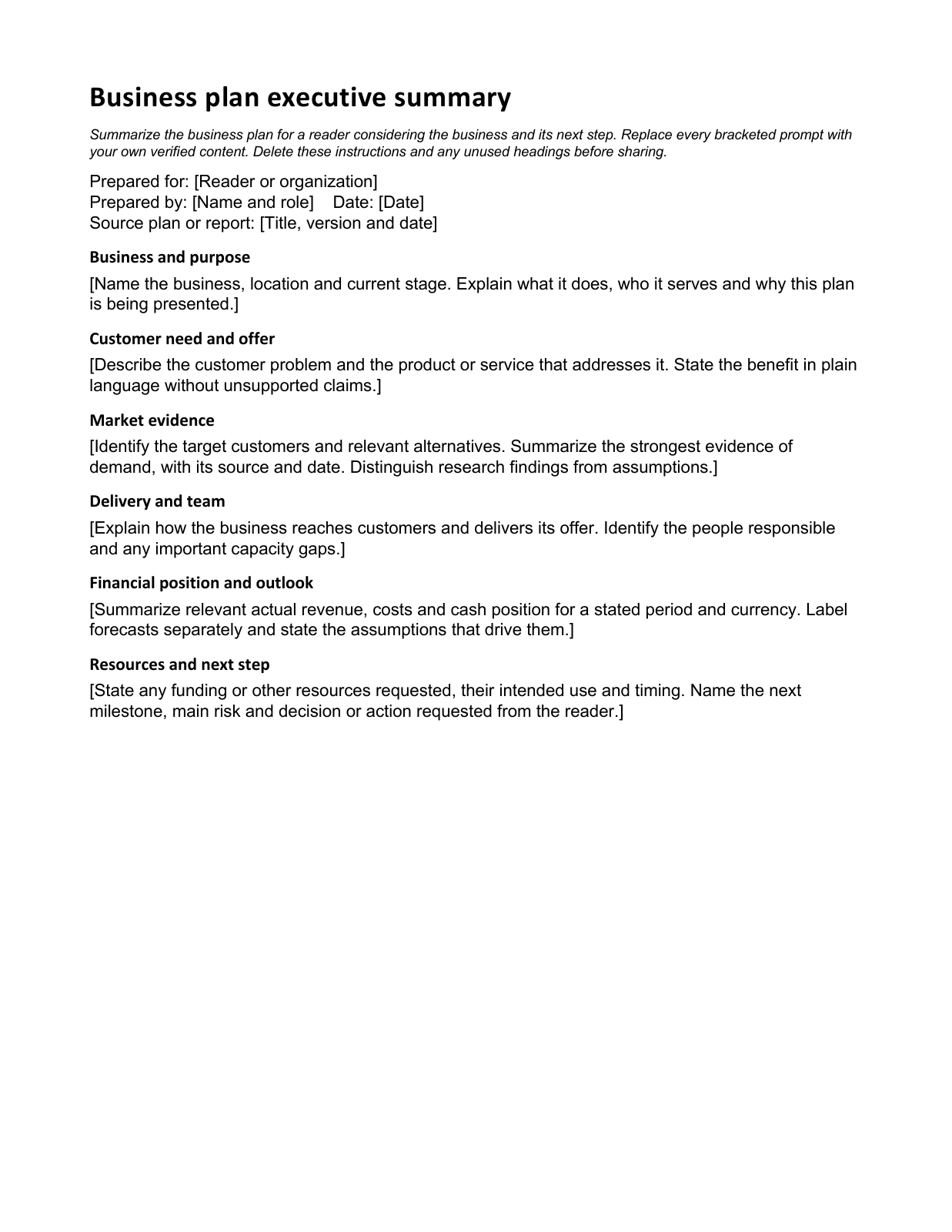
01 — Business Plan Executive Summary Template
02 Research report executive summary
This version follows a report from its question and method to findings, limitations and a recommendation. Use it when the reader needs to assess what the evidence supports. If the research does not justify a firm conclusion, say what remains uncertain instead of forcing a positive recommendation.
02 — Research Report Executive Summary Template
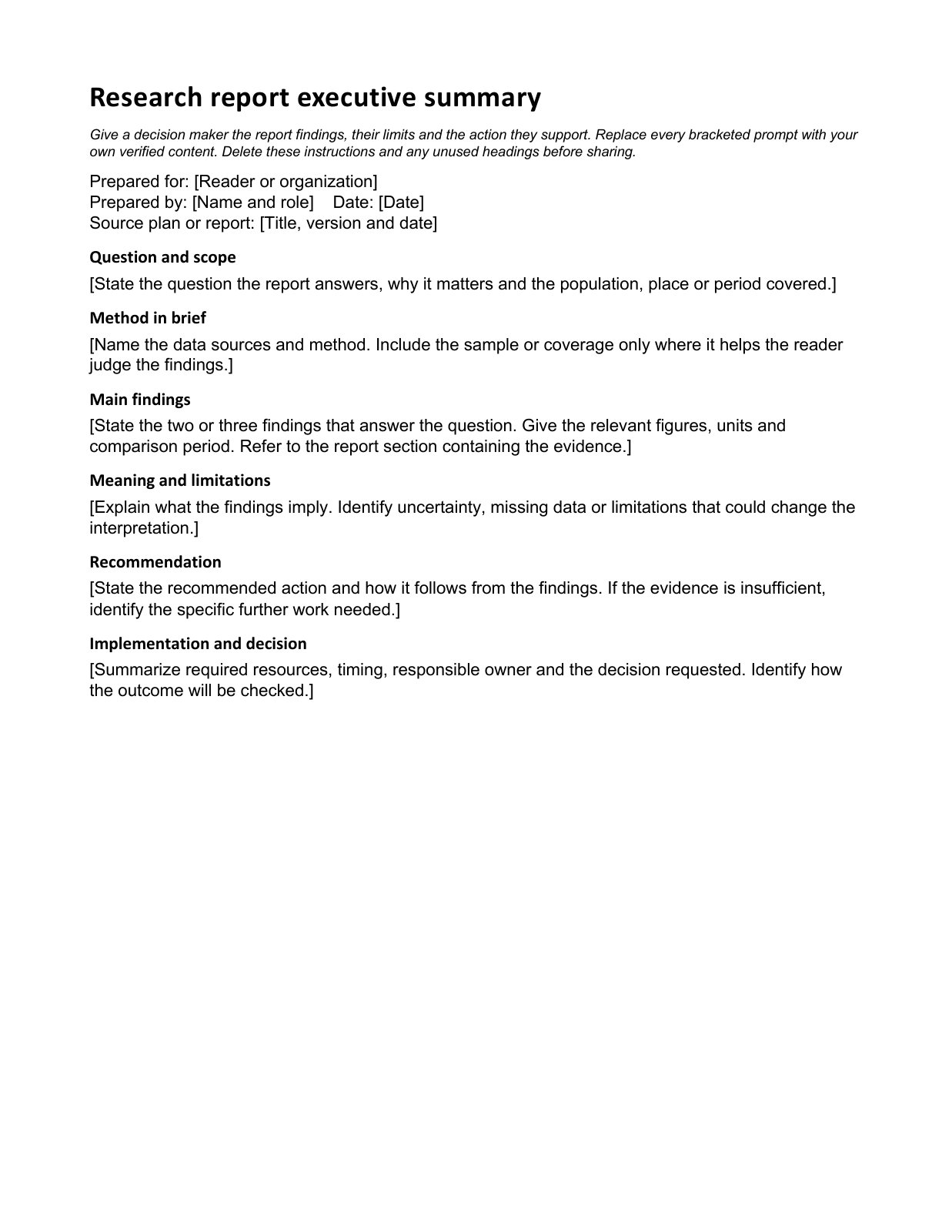
02 — Research Report Executive Summary Template
03 Funding request executive summary
Bring the requested amount and use of funds together with the business's actual financial position, forecast assumptions and supporting records. The prompts distinguish a funding discussion from an application. Follow the lender's or funding provider's instructions; the template does not establish eligibility or promise approval.
03 — Funding Request Executive Summary Template
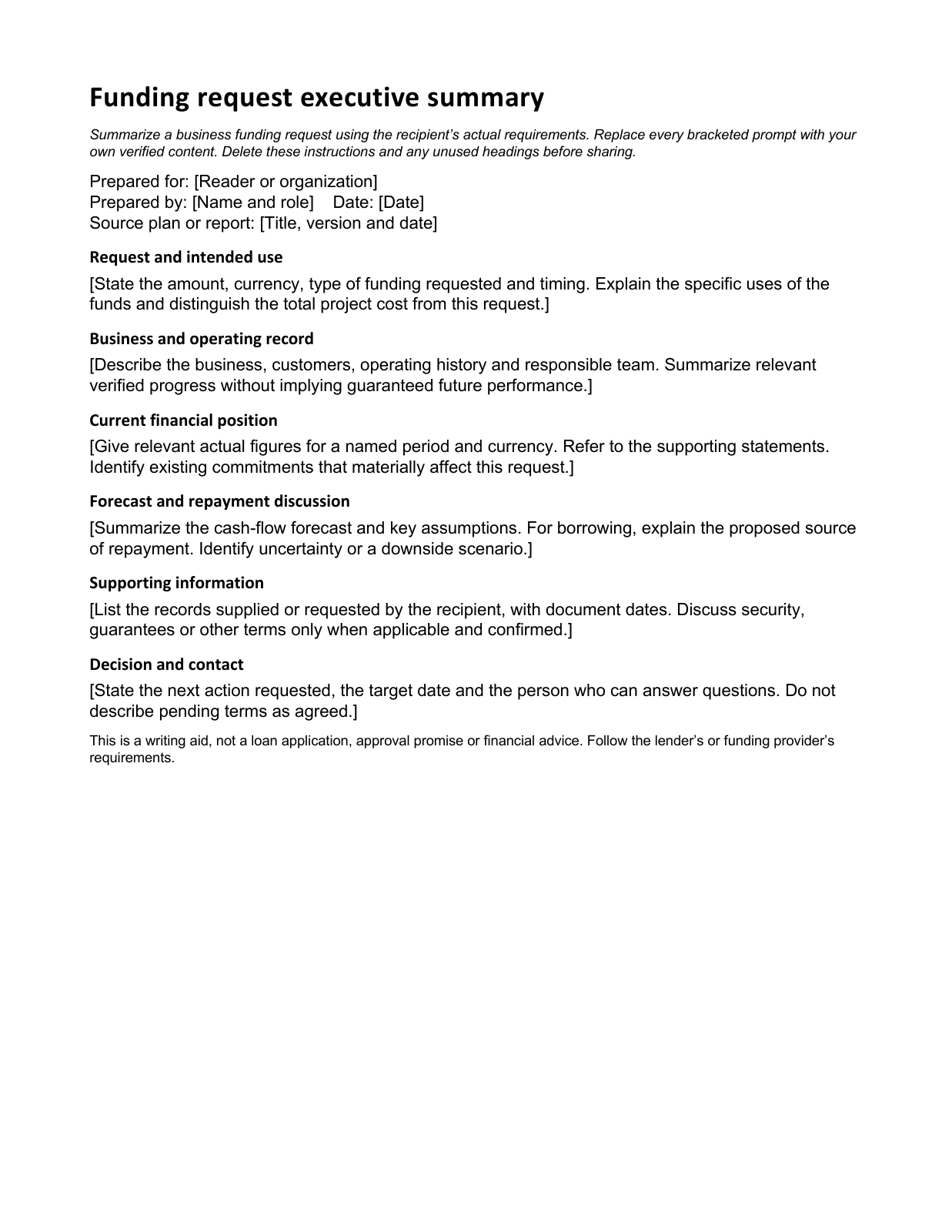
03 — Funding Request Executive Summary Template
04 Company performance executive summary
Summarize results for a defined reporting period, compare them with the plan and explain the most significant changes. This file gives space to distinguish confirmed drivers from possible explanations, then identify the management action needed.
04 — Company Performance Executive Summary Template
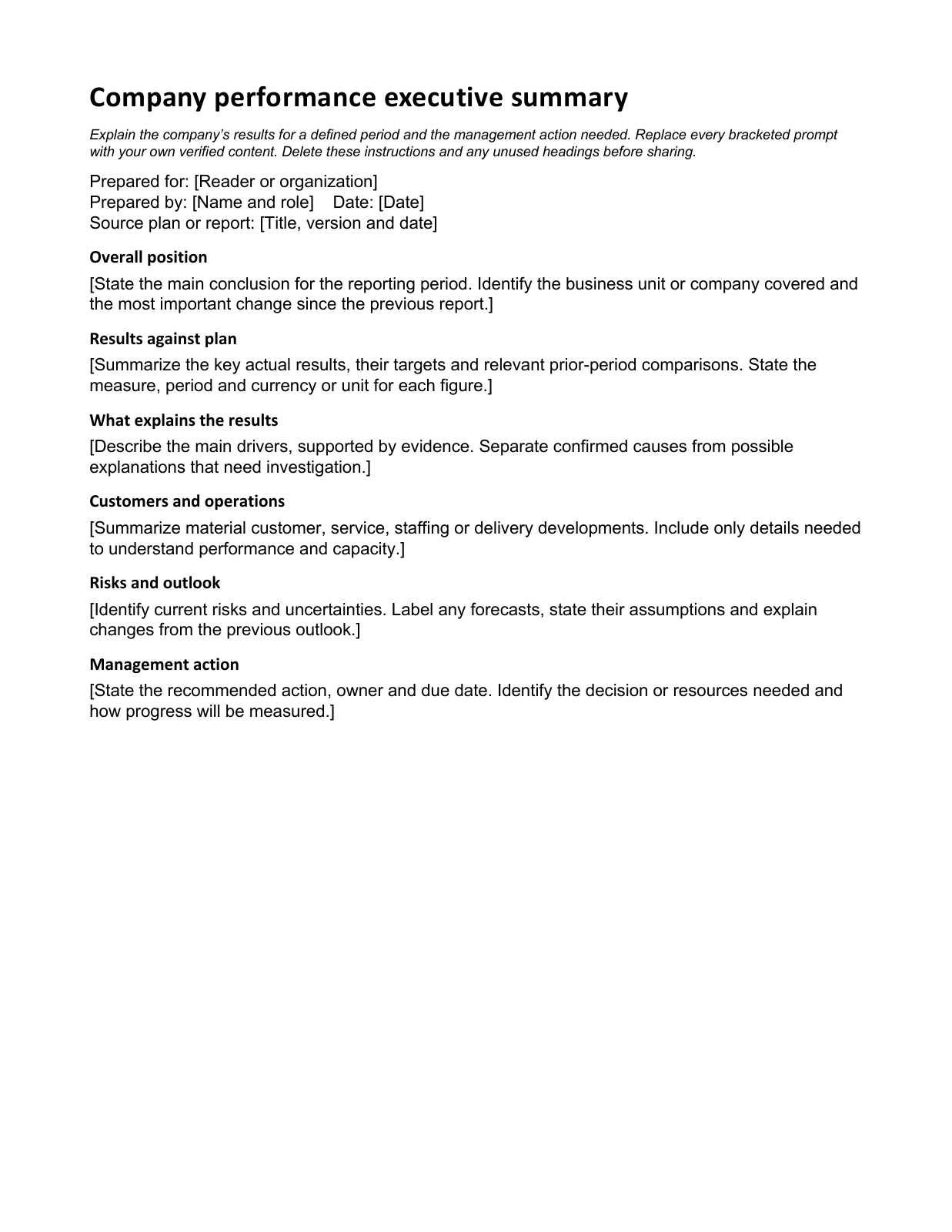
04 — Company Performance Executive Summary Template
05 Product and service executive summary
Describe the customer need, the offers being considered and evidence of demand or performance. Separate entries for three products or services can be expanded or deleted. Include the delivery constraints and proposed next step that matter to the decision, rather than listing every feature.
05 — Product and Service Executive Summary Template
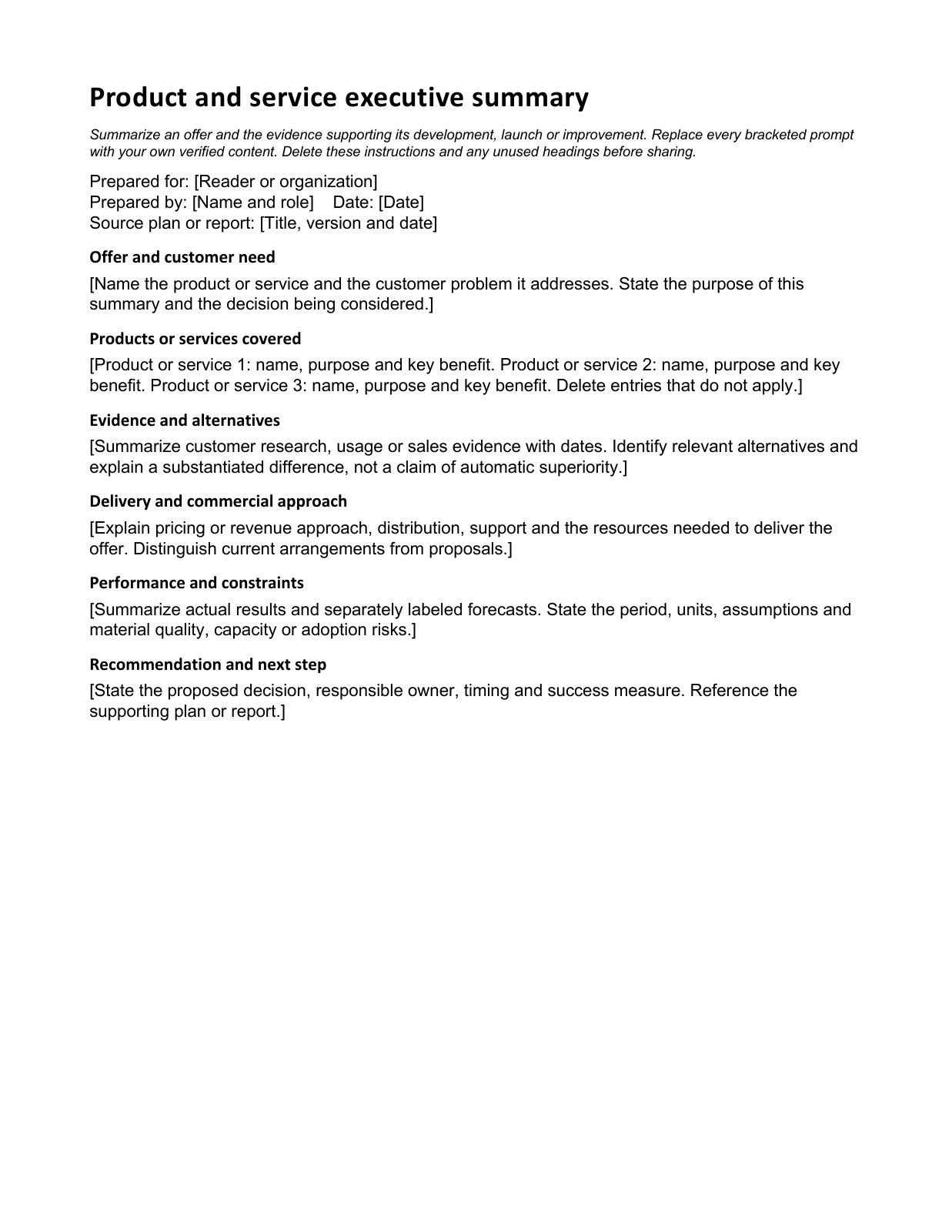
05 — Product and Service Executive Summary Template
06 Strategy executive summary
Use this when the reader must choose a direction. It connects the starting position and objectives with options, resources, milestones and risks. Name the assumptions that should be monitored as the strategy proceeds.
06 — Strategy Executive Summary Template
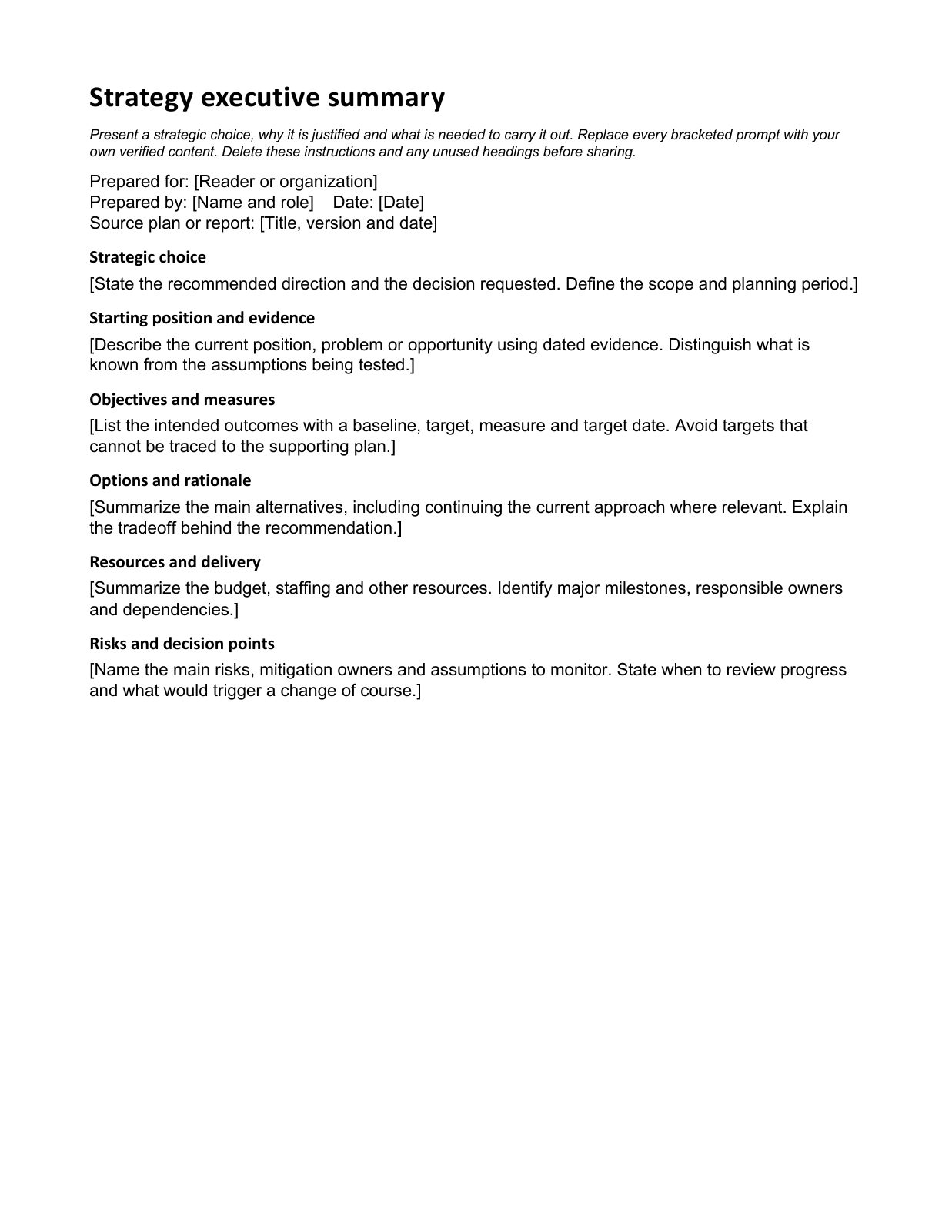
06 — Strategy Executive Summary Template
07 Startup executive summary
Explain the venture's current stage and the evidence gathered so far. The prompts cover customer validation, the business model, team, financial baseline and next milestone. Label projections clearly, especially when the business has limited trading history.
07 — Startup Executive Summary Template
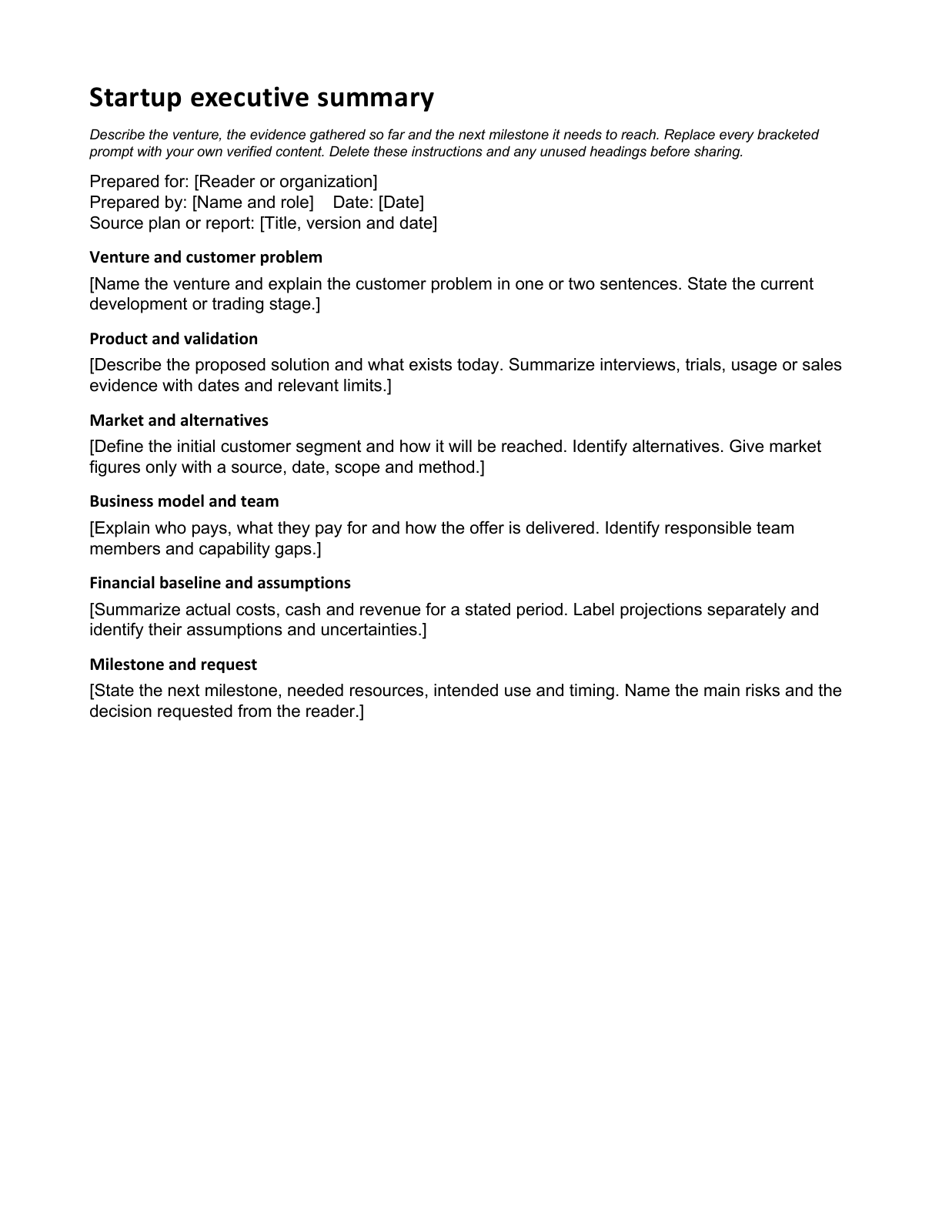
07 — Startup Executive Summary Template
08 Investor discussion executive summary
Prepare an introduction for an initial business funding discussion, with dated traction measures, financial context, resource needs and material risks. This writing aid is not an investment offering, valuation or recommendation. Proposed terms should not be presented as agreed, and projected business revenue should not be described as a guaranteed investor return.
08 — Investor Discussion Executive Summary Template
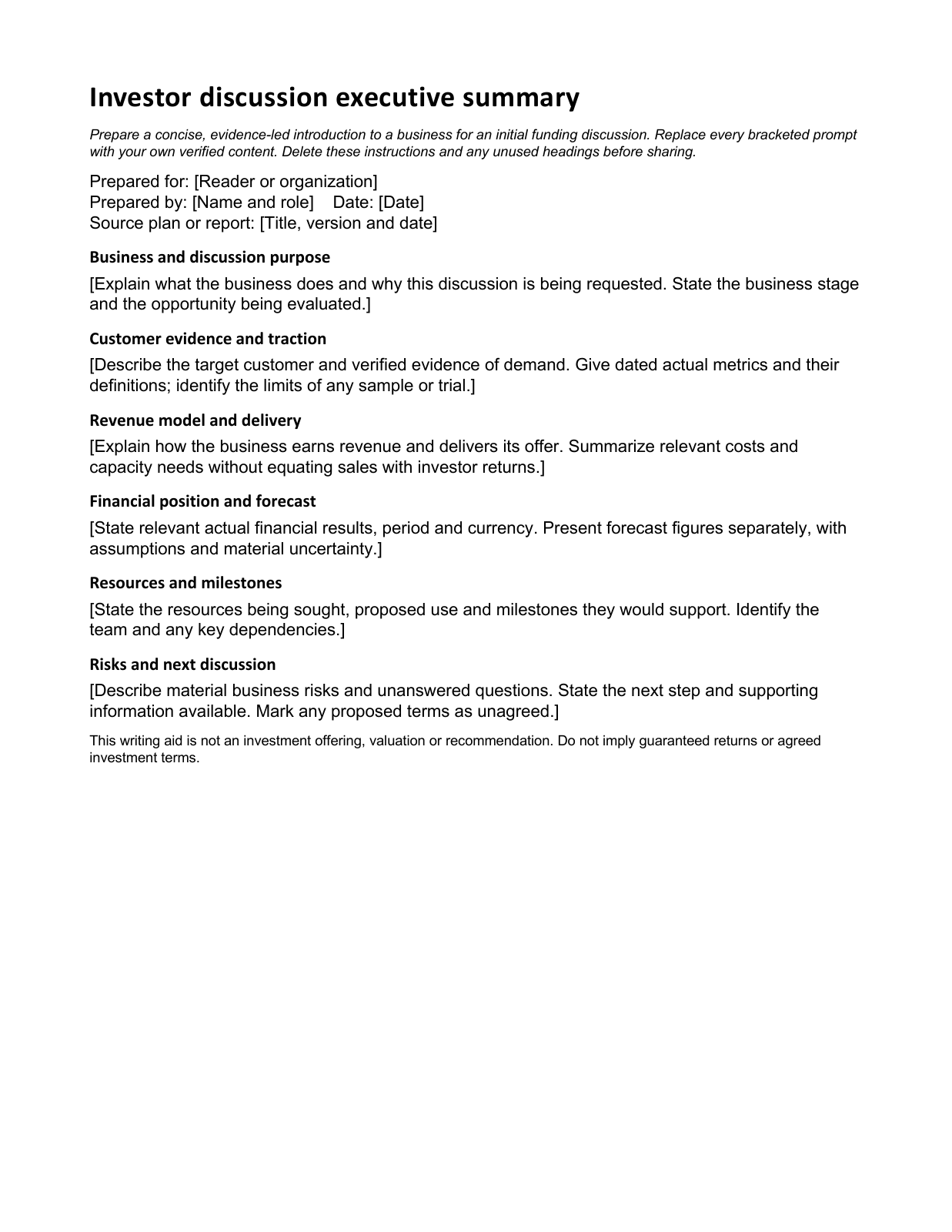
08 — Investor Discussion Executive Summary Template
09 Marketing program executive summary
Outline a campaign or program for a named audience, market and period. The file connects the evidence and baseline to objectives, activities, budget and review dates. It can also support a regional program when those prompts fit the work.
09 — Marketing Program Executive Summary Template
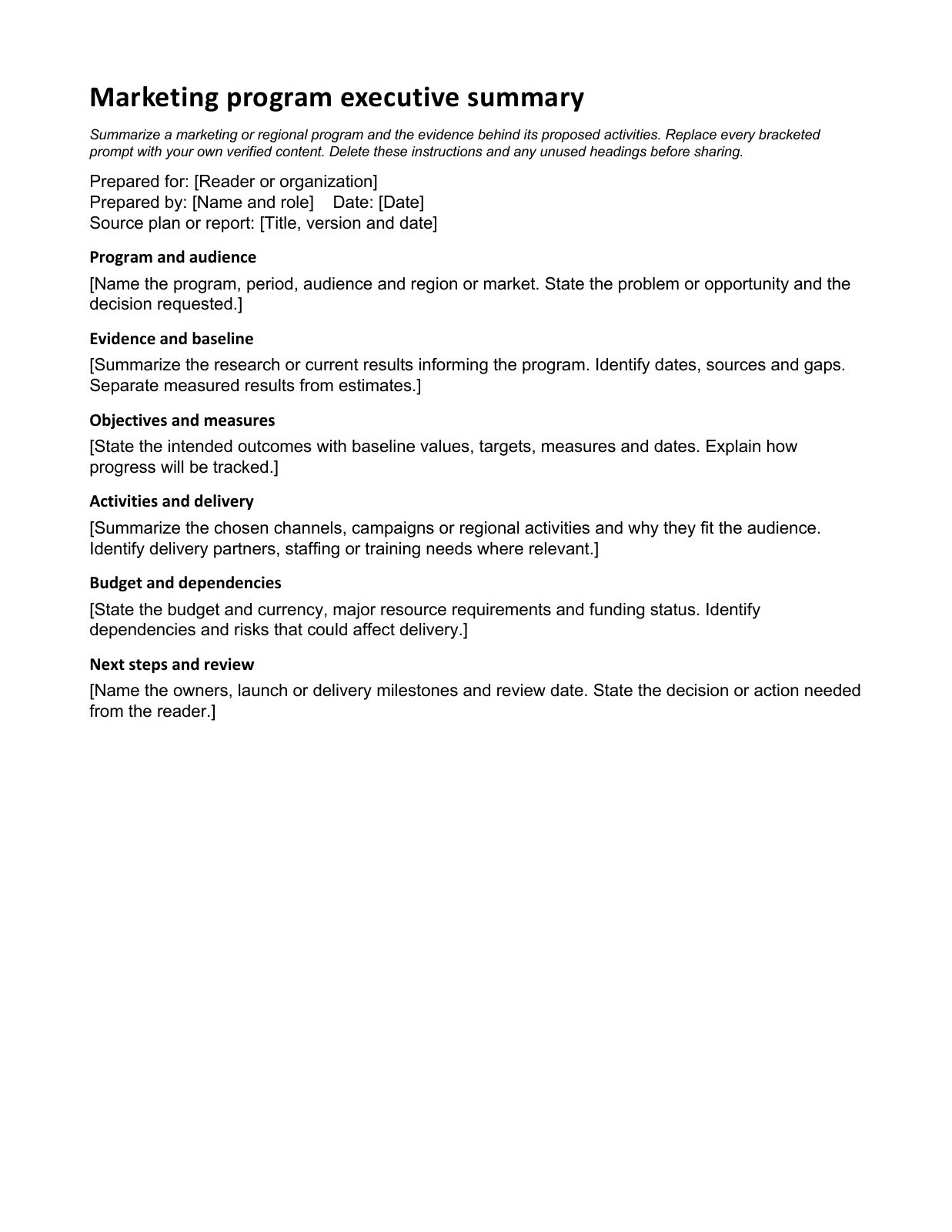
09 — Marketing Program Executive Summary Template
10 Project decision executive summary
Put the requested decision first, then compare the options and explain the recommendation. Include costs, timing, dependencies and a named next-action owner so the reader knows what approval would lead to.
10 — Project Decision Executive Summary Template
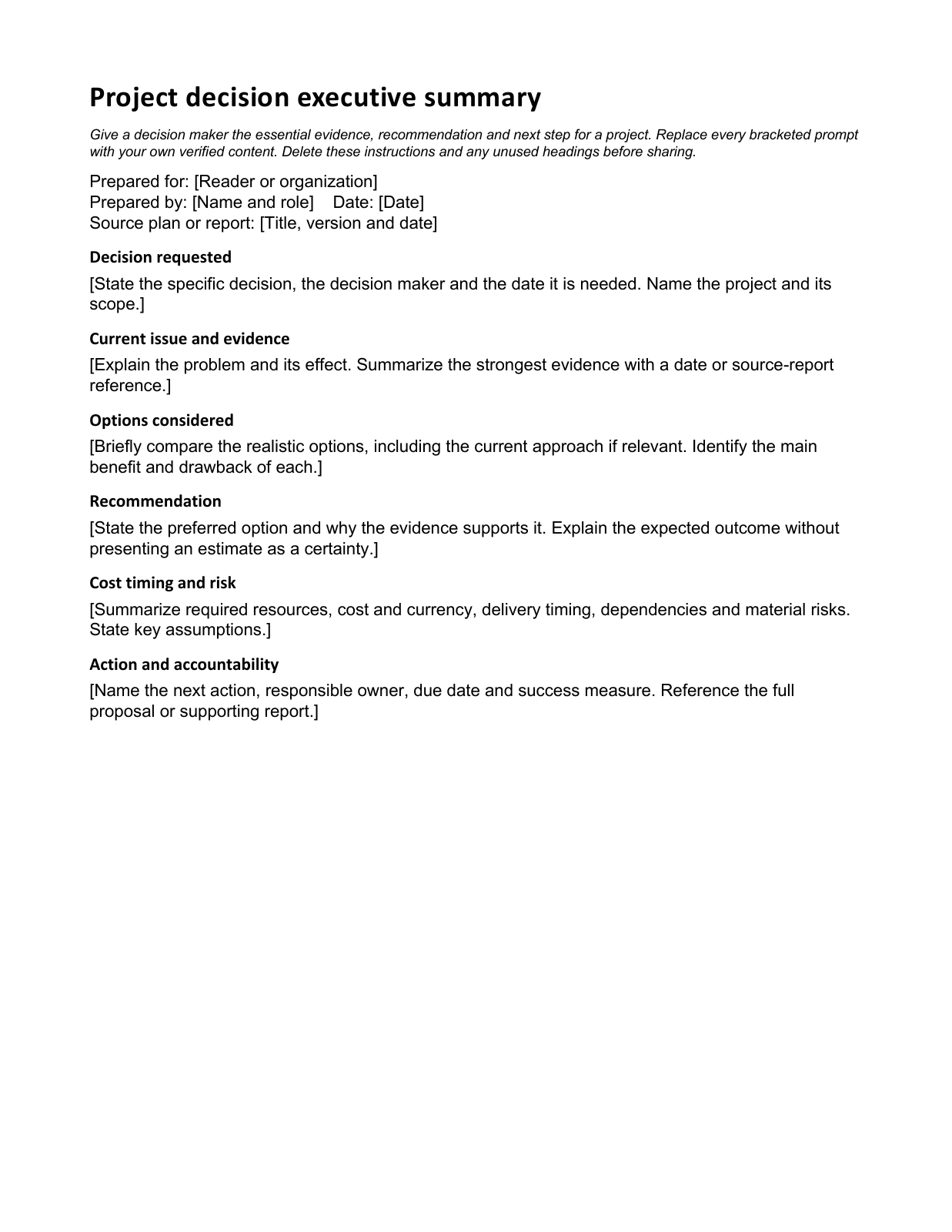
10 — Project Decision Executive Summary Template
How to turn a report into a useful summary
Write the underlying plan or report before finalizing its summary. The University of Melbourne recommends writing the executive summary last and checking that it reflects the report's sections. That helps prevent a polished opening from promising something the actual report does not support.
University of Melbourne: Executive summaries
Start with the reader's question. Are they being asked to approve a budget, consider a proposal or understand results? State that purpose early. A sentence such as “This report recommends a six-week trial of the revised booking process” gives the reader a clearer starting point than “This report explores several important opportunities.”
Next, select the evidence needed to understand the conclusion. For a research report, that might mean the main finding and the limits of the sample. For a business plan, it might mean evidence of demand, operating capacity and the resources required. Leave the detailed workings in the source document, but include a section or appendix reference when the reader may need to check them.
Keep the recommendation connected to the evidence. Explain why the preferred option addresses the problem, what it would require and what could change the outcome. If the evidence is incomplete, recommend a defined next investigation or trial instead of presenting uncertainty as a settled result.
Make numbers traceable
A figure needs enough context to mean something: its unit or currency, period, definition and source. “Revenue grew” is less useful than a statement showing the two periods being compared. Equally, a forecast should identify the assumptions behind it rather than appear beside actual results without a label.
For example, “The trial reduced the average processing time from 12 to 9 minutes” reports a measured result if the records support it. “A wider rollout could save approximately 20 staff hours per month” is an estimate; explain the volume and time assumptions used to calculate it. These are illustrative statements, not results from a DocTemplates test.
An original project-summary example
The following fictional example shows how a short summary can connect a problem, evidence, recommendation and decision. All organizations, figures and proposed actions in it are invented for illustration.
“The operations team recommends a six-week pilot of a shared booking calendar at one branch. A review of 100 bookings found 18 that required follow-up because staff used separate calendars. The review covered one week, so it does not establish an annual error rate.
“The pilot would give the branch one booking view and a named daily coordinator. It requires a budget of $600 for setup and training, based on the team's preliminary estimate. The main risk is that inconsistent use could leave duplicate records in place.
“The branch manager is asked to approve the pilot by 8 November. The operations lead would report the number of booking corrections and staff time spent on follow-up at the end of the six weeks. A wider rollout would depend on those results.”
The example states what is known, identifies its limits and makes the next decision concrete. Its small sample supports a pilot proposal; it does not prove that the same result will occur across every branch.
Executive summary or introduction
An executive summary tells the reader what the report found and what follows from it. An introduction sets up the report's purpose, background and scope. The University of Melbourne treats the summary as a separate, self-contained section before the main report, rather than a replacement for the introduction.
If your opening describes what the report will examine but never states its findings or recommendation, you probably have an introduction. Keep it where it belongs and write a summary that gives the reader the outcome as well.
How long should it be
Follow the recipient's instructions when a length or format is specified. Otherwise, include enough information to understand the main conclusion, evidence and action without reproducing the report. A short proposal may need only a few paragraphs; a complex report may need more explanation.
The templates begin as one-page layouts, but the editable Word and Google Docs files can grow as you replace the prompts. A starting page count is not a required final length. Cut repetition before shrinking the font, and check the exported PDF after editing so headings and paragraphs break in sensible places.
Check it before sharing
Read the summary once without the full report beside it. Can you identify the purpose, main result, recommendation and requested action? Then compare it with the report and check that every important claim agrees.
Remove all bracketed prompts and unused headings. Confirm names, dates, figures and source-document references. Distinguish actual results from estimates, explain material uncertainty and avoid promises the evidence cannot support. Finally, open the edited document and exported PDF to check page breaks and readability before sending the version your reader needs.
